Mythos Has Broken the Remediation Model. Machine Speed Is Now the Minimum.

Frontier AI is now uncovering source code vulnerabilities that humans missed for years, shrinking the time-to-exploit from weeks to just hours. But remediation still takes weeks. 

In 30 minutes, a Qualys expert will walk you through:

  • Window of exposure 
  • KEV coverage
  • Zero-day remediation

Get Your Mythos Briefing

Manage Risk in the Post-Mythos Era

Operationalize your transition to autonomous remediation with Qualys. 

Autonomous Validation Orchestration

What is Mythos?

On April 7, 2026, Anthropic announced Claude Mythos Preview, a frontier AI model under Project Glasswing capable of autonomously discovering and exploiting software vulnerabilities. Released as a private beta with selected partners, its goal is to identify and remediate critical vulnerabilities in commonly deployed software before adversaries discover and exploit these

The result is a new era of accelerated vulnerability discovery, driving a surge in disclosures, patches, and CVEs at a pace security teams have never had to manage before.

Autonomous Validation Orchestration

What is Changing?

Mythos marks a structural shift in vulnerability management: discovery is becoming continuous, automated, and massively scaled. Vulnerabilities that once took human researchers weeks or months to uncover can now be identified and exploited in hours.

This is compressing the exploitation window and accelerating disclosure cycles, creating a growing gap between “vulnerability found” and “risk actually remediated.” At the same time, the volume of findings is increasing dramatically, while only a small fraction of vulnerabilities are ever truly exploited.

What is Mythos?

On April 7, 2026, Anthropic announced Claude Mythos Preview, a frontier AI model under Project Glasswing capable of autonomously discovering and exploiting software vulnerabilities. Released as a private beta with selected partners, its goal is to identify and remediate critical vulnerabilities in commonly deployed software before adversaries discover and exploit these.

The result is a new era of accelerated vulnerability discovery, driving a surge in disclosures, patches, and CVEs at a pace security teams have never had to manage before.

What is Changing?

Mythos marks a structural shift in vulnerability management: discovery is becoming continuous, automated, and massively scaled. Vulnerabilities that once took human researchers weeks or months to uncover can now be identified and exploited in hours.

This is compressing the exploitation window and accelerating disclosure cycles, creating a growing gap between “vulnerability found” and “risk actually remediated.” At the same time, the volume of findings is increasing dramatically, while only a small fraction of vulnerabilities are ever truly exploited.

Schedule a demo

The State of The Union According to the 2026 Verizon DBIR Report

Vuln exploitation

Top initial access method for attackers

43 days

Median time to full remediation

50% more

Critical vulnerabilities vs. twelve months ago

See how AI-speed remediation closes the gap attackers exploit

Frontier AI has cut exploit timelines from weeks to hours. Watch how the Qualys Risk Operations Center combines AI-powered detection, hyper-prioritization, and autonomous remediation into one continuous workflow — so you can act as fast as the threats you're defending against.

No-Cost, 30-Day Trial

The Post-Mythos Era: AI-Powered Cybersecurity & Autonomous Risk Operations Explained

The Path Forward: Autonomous Remediation

Today, security teams need an operating model built for machine speed: detect exposures continuously, validate what is truly exploitable in your environment, and eliminate risk autonomously. 

icon

AI-Speed Detection

With vulnerability exploitation now the leading breach vector, stale inventories and periodic scans are a liability. Qualys VMDR delivers continuous, real-time visibility — now with InstaScan for scanless, minutes-from-disclosure detection, and Total AI 2.0 for AI attack surface discovery and governance.

icon

Hyper-Prioritization

Volume has broken the model — most KEV-listed vulnerabilities remain unpatched while attackers exploit the gap. Qualys ETM pinpoints what's truly exploitable in your environment, and new agent-based TruConfirm extends that validation to internal assets for full attack-path coverage.

icon

Zero-Day Remediation

As the window between disclosure and exploitation shrinks, Qualys TruRisk Eliminate delivers resilient, risk-aware remediation with AI-powered reliability scoring and rollback safeguards. New wave-based patching, guided by agent Sara, plus an enhanced reliability score blending global intelligence with your own telemetry, make every rollout sharper.

Is Your Team Ready for AI-Speed Attacks? 

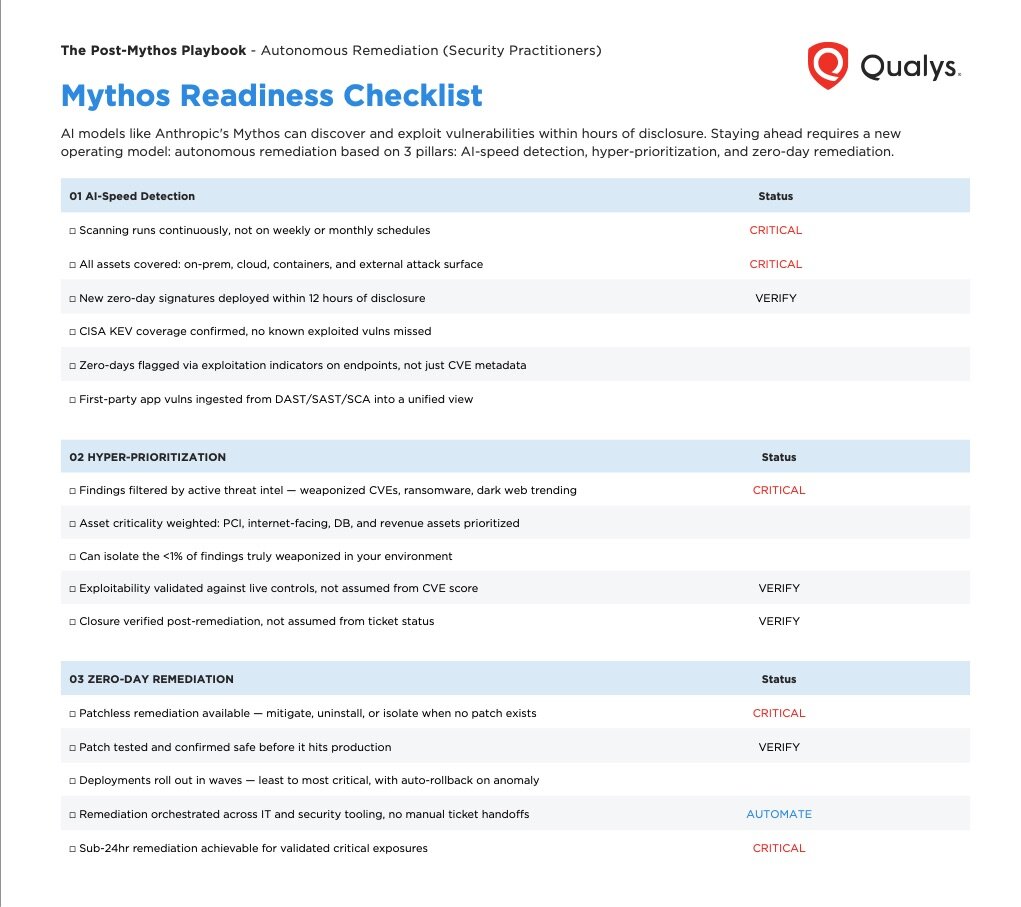
Download the checklist, score your posture across three pillars, and know exactly where your program stands. 

Elevate Your Cyber Risk Management Strategy

Industry-Proven. Production-Tested. 

Noise reduction

>95%

From findings to validated risk

Patches deployed in last 12 months

150M+

Autonomous validation

Automated patches applied

40M

with <0.1% rollback rate

#1 ranked by GigaOm in the Patch Management Radar 2025 

Related Resources

<p>Info-Tech Research Group - Independent Tech Note</p>
Tech Note

Info-Tech Research Group - Independent Tech Note

<p>Pivotal Moment: Capitalize on Mythos Hype to Fix Your Exposure and Vulnerability Management </p>
Report

Pivotal Moment: Capitalize on Mythos Hype to Fix Your Exposure and Vulnerability Management

<p>Learn How to Manage Risk in the Post-Mythos Era</p>
Webinar

Learn How to Manage Risk in the Post-Mythos Era

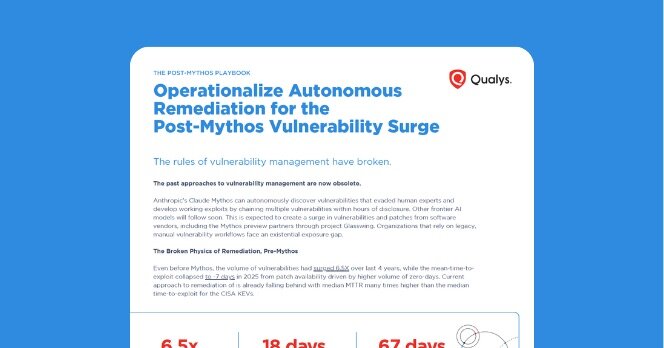
<p>Operationalize Autonomous Remediation for the Post-Mythos Vulnerability Surge</p>
One-pager

Operationalize Autonomous Remediation for the Post-Mythos Vulnerability Surge

<p>The Physics of Remediation are Breaking</p>
Report

The Physics of Remediation are Breaking

<p>The Mythos Inflection Point: Dealing With the Upcoming Vulnerability Disclosure Avalanche and Compressed Exploitation Window</p>
Blog

The Mythos Inflection Point: Dealing With the Upcoming Vulnerability Disclosure Avalanche and Compressed Exploitation Window

<p>Handling the Vulnerability Surge in the Post-Mythos Era</p>
Blog

Handling the Vulnerability Surge in the Post-Mythos Era

Frequently Asked Questions

What exactly is changing with Mythos, and why does it matter now?

AI-driven systems like Claude Mythos Preview are fundamentally changing the economics of vulnerability management. Three structural shifts are happening simultaneously:

Vulnerabilities are being discovered at unprecedented scale; Anthropic reports thousands of zero-days surfaced in private testing. More models will discover vulnerabilities at machine-speed, increasing the surge of detections – 2x/3x. This surge will sit on the existing backlog of open vulnerabilities which were on avg. increasing by 3K/month.

Exploits are now developed within hours — or even before public disclosure (“Day -1”).

Average industry remediation timelines (~67 days) cannot keep pace with sub-20-hour exploit windows.

Only ~0.74% of vulnerabilities are weaponized in the attacks/actually exploited in the wild, yet responsible for the 90%+ attacks, yet teams are forced to triage 100% of findings under traditional models, resulting in wasted remediation cycles and cost, not closing the risks that matter!

Is Qualys part of Project Glasswing?

Yes. Qualys was invited by Anthropic to participate in Project Glasswing, a program that brings together leading technology and cybersecurity organizations to evaluate the security implications of advanced AI systems. Qualys is also participating in OpenAI’s Trusted Access for Cyber program.

How will Mythos change the frequency by which vulnerabilities in the Qualys database are updated?

Qualys already leads the industry in vulnerability response times. Led by Pwnie award winning threat research team of 120+ researchers, our average response for critical vendors is 6 hours. We have invested heavily in streamlining our vulnerability signature development pipeline through extensive automation across research, QA, and engineering workflows. Today, the majority of newly disclosed vulnerabilities are added to the Qualys database within hours of public disclosure. That pipeline is built to scale with disclosure volume — meaning the Mythos-driven surge will not slow signature delivery.

How does Qualys provide agentic AI to drive risk outcomes — not just chat?

If you already know the right question to ask, a human would have already built the workflow. Agentic AI is not about generating prettier reports or writing tickets faster — it is about unlocking autonomous, measurable risk reduction. Qualys ships Cyber Risk Agents as out-of-the-box agents purpose-built for specific risk outcomes, not as a chatbot overlay waiting for a prompt.

Agent Nyra — Threat-Based Prioritization. Aligns risk posture with active industry threats; highlights only the security gaps attackers are currently weaponizing. Outcomes: 85% monitoring of trending threats, 22% reduction in cyber risk, 30% faster adversary risk mitigation.

Agent Sara — Patch Tuesday Sidekick. Identifies monthly Patch Tuesday updates, maps impacted assets and high-priority CVEs, and creates targeted remediation jobs for testing and production environments. Outcomes: 15% TruRisk points eliminated, 75% faster patch closure, 30% faster adversary risk mitigation.

Agent Nova — External Attack Surface. Hacker’s-eye view of your internet-facing assets, revealing toxic combinations of open ports, listening services, risky vulnerabilities, and business context. Outcomes: 25% unknown-asset discovery, 15% hidden-risk reveal, 90% faster detection of risk.

Agent Sophia — CISA KEV & Ransomware Defense. Eliminates the vulnerabilities that actually cause breaches. Aligns your environment with CISA mandates, isolating Known Exploited Vulnerabilities (KEVs) and confirmed ransomware vectors for immediate remediation. Outcomes: 99% visibility of internet-facing assets, 60% reduction in noise, 4x faster detection for critical CVEs.

Agent Sid — Hacker’s-Eye View of your risk. Continuously monitors your external attack surface — high-risk exposures and toxic combinations of risky open ports, exposed databases, expired certificates, vulnerable services — reducing your MTTD. Outcomes: 15% TruRisk points eliminated, 75% faster patch closure (MTTR), 30% faster adversary risk mitigation.

Agent Val — Safe Exploit Validation with Proof. Validates whether high-risk exposures are exploitable in production using attacker-technique testing. Removes theoretical risk, proves control effectiveness, and gives Security and IT Ops shared evidence to minimize change friction with suppressed noise. Outcomes: 90% reduction in remediation noise, 55% reduction in TruRisk score, 70% manual-effort reduction.

Agentic AI is what makes the “close the loop attackers can’t outrun” promise operationally real. It is the layer that takes Hyper-Prioritization to a validated, remediated, re-verified outcome — without humans approving every step.

How does Qualys address zero-day vulnerabilities?

Three layers operate in parallel for high-impact and zero-day scenarios:

Threat intelligence via Qualys TruLens detects active exploitation campaigns and emerging weaponization signals.

Validation via Qualys TruConfirm confirms real exposure on customer assets with current controls.

Automated response via Agent Val and Sara identifies impacted assets, builds remediation plans, and launches patch, mitigation, or isolation workflows. Time from disclosure to risk reduction drops from days to hours.

How does Qualys address validation, exposure management, and adaptive capabilities such as WAF virtual patching?

TruRisk Eliminate operates across the full remediation spectrum, not just patching. When a patch is not yet available or cannot be deployed in the required window, Qualys drives compensating controls: WAF virtual patching rules, configuration changes, runtime mitigations, network isolation, and removal of unused or end-of-life software. Mitigation is treated as a primary remediation strategy, not a fallback.