CISA BOD 26-04 Has Broken the Patch-Everything Model.

A 72-Hour Clock is Now the Standard.

Federal agencies must move from patch volume to measurable risk elimination.

BOD 26-04 requires the highest-risk exposures to be remediated within 72 hours, with forensic triage before patching.

Get your custom briefing today.


:
:

Days          Hour          Min

Dec 7

Final Deadline for Mandate

Don't Let the Clock Run Out

Manage Risk in the Post-Mythos Era

Operationalize your transition to autonomous remediation with Qualys. 

Manage Risk in the BOD 26-04 Era

Operationalize continuous, auditable risk reduction with a federal Risk Operations Center powered by Qualys.

What is BOD 26-04?

Federal Vulnerability Management Has Changed.

CISA BOD 26-04 moves federal agencies from patch-everything strategies to risk-based vulnerability management. The highest-risk exposures must be remediated within 72 hours, with forensic triage required before patching.

Live
Webinar

Live Webinar

FedRAMP Authorization and What It Now Takes to Keep It

Wednesday, Sept 2nd | 9:00 AM PT | 12:00 PM ET

Join Kaleb Knobel, Senior Security Analyst & ISSO and Anu Kapil, Director of Product Management at Qualys for a practical walkthrough of what VDR and VER change across FedRAMP Moderate and High environments.

Webinar

FedRAMP Authorization and What It Now Takes to Keep It

Join Kaleb Knobel, Senior Security Analyst & ISSO and Anu Kapil, Director of Product Management at Qualys for a practical walkthrough of what VDR and VER change across FedRAMP Moderate and High environments.

Shailesh Athalye
Shailesh Athalye

Kaleb Knobel

Senior Security Analyst & ISSO

Jonathan Trull

Anu Kapil

Director of Product Management

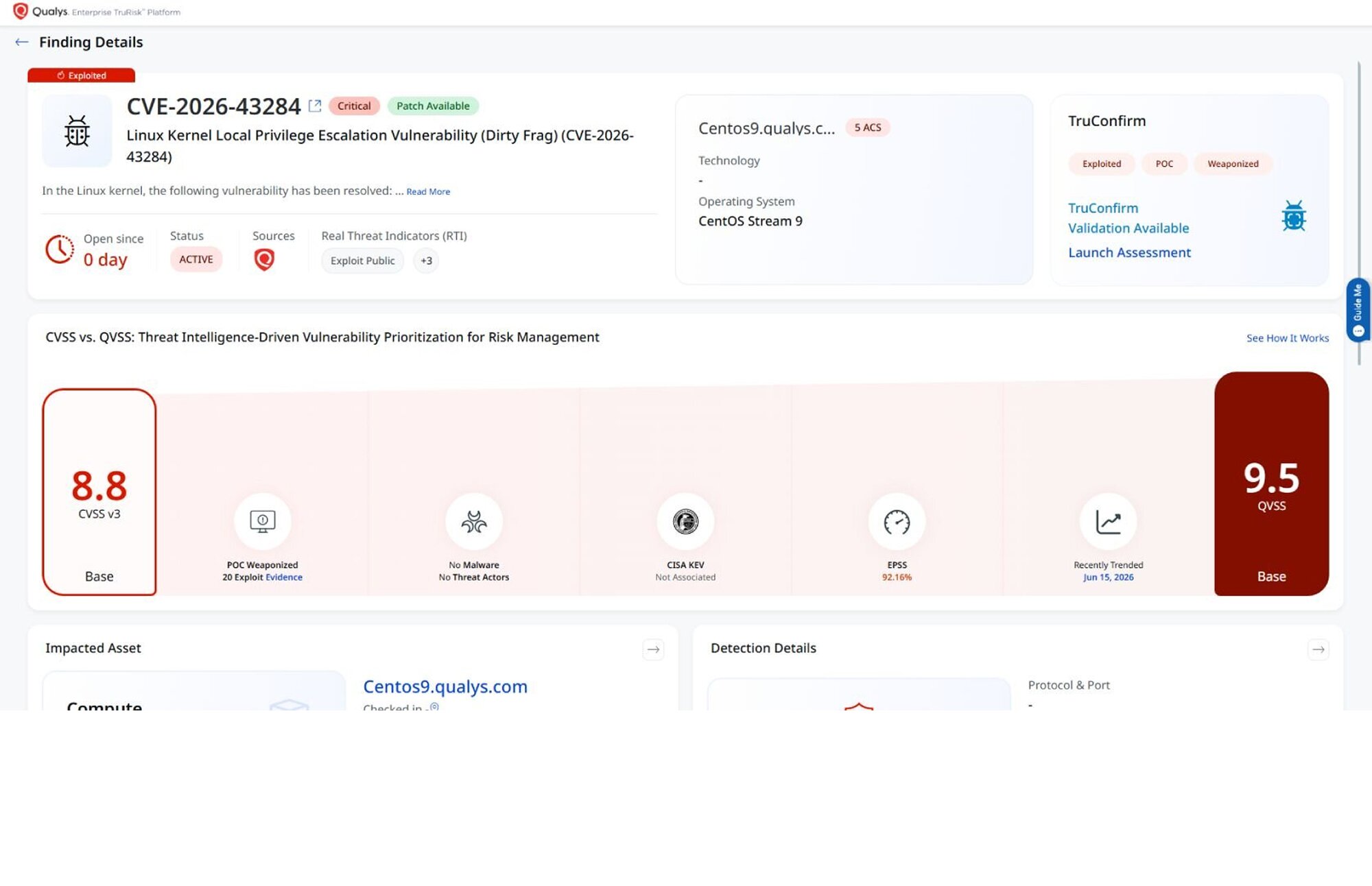
Remediation Urgency Is Set by Four Attributes of a Vulnerability

Security and IT operations need a shared operating model — one that replaces manual handoffs with continuous, automated workflows across detection, prioritization, and remediation.

This is the foundation of the Risk Operations Center (ROC) powered by Qualys.

Asset Exposure

Is the asset publicly / internet exposed?

KEV Status

Is the CVE on CISA's Known Exploited Vulnerabilities catalog?

Exploit Automation

Can an adversary fully automate every step of exploitation?

Technical Impact

Does exploitation give partial or total control of the asset?

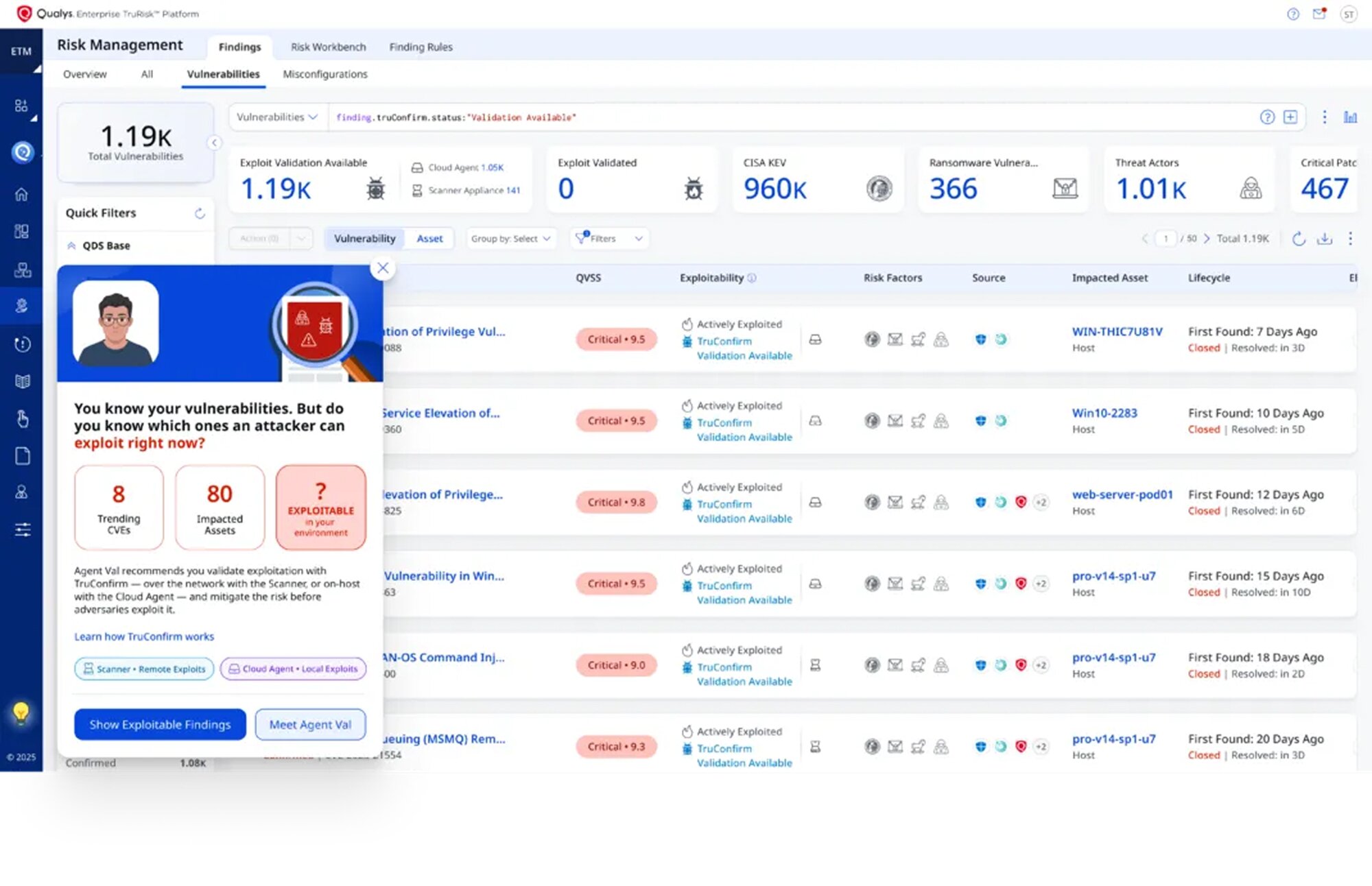
Autonomous Validation Orchestration

More Findings. Less Time. More Board Risk.

Mythos has turned vulnerability discovery into a continuous, automated race. What used to take weeks can now compress into hours, and the volume of disclosures keeps climbing. But the real concern for CISOs is not the flood of findings. It is the small number that are confirmed, weaponized, and reachable in your environment.

The window to act is shrinking. The question is whether your program was built to find signal in the noise before an attacker does it for you.

What is Mythos?

On April 7, 2026, Anthropic announced Claude Mythos Preview, a frontier AI model under Project Glasswing capable of autonomously discovering and exploiting software vulnerabilities. Released as a private beta with selected partners, its goal is to identify and remediate critical vulnerabilities in commonly deployed software before adversaries discover and exploit these.

The result is a new era of accelerated vulnerability discovery, driving a surge in disclosures, patches, and CVEs at a pace security teams have never had to manage before.

What is Changing?

Mythos marks a structural shift in vulnerability management: discovery is becoming continuous, automated, and massively scaled. Vulnerabilities that once took human researchers weeks or months to uncover can now be identified and exploited in hours.

This is compressing the exploitation window and accelerating disclosure cycles, creating a growing gap between “vulnerability found” and “risk actually remediated.” At the same time, the volume of findings is increasing dramatically, while only a small fraction of vulnerabilities are ever truly exploited.

The Current Situation:

The vulnerability volume is up, the remediation timelines are shorter and the handoffs between security and IT are still largely manual, creating a gap where more gets found than fixed, and neither team has full confidence in what's actually exploitable.

That misalignment isn't a people problem. It's an operating model problem. 

The Problem Your Team Is Living Every Day

The vulnerability volume is up.

The remediation timelines are shorter.
The handoffs between security and IT are still largely manual.

The result is a gap that keeps growing:

Security finds more than IT can fix


IT fixes things security didn't flag as urgent


Neither team has full confidence in what's actually exploitable


Security finds more than IT can fix
IT fixes things security didn't flag as urgent
Neither team has full confidence in what's actually exploitable

That misalignment isn't a people problem. It's an operating model problem. 

The Problem Your Team Is Living Every Day:

The vulnerability volume is up.

The remediation timelines are shorter.

And the handoffs between security and IT are still largely manual. 

The Result Is a Gap That Keeps Growing:

Security finds more than IT can fix

IT fixes things security didn't flag as urgent

Neither team has full confidence in what's actually exploitable 

That misalignment isn't a people problem. It's an operating model problem. 

The New Reality

AI Has Compressed Exploitation Timelines. From Weeks To Hours.

BOD 26-04 is CISA's response to a new threat landscape where attackers can discover and weaponize vulnerabilities faster than traditional remediation programs can respond.

The Numbers Behind the Shift

~50,000 CVEs

disclosed in 2025

0.74% Of CVEs

became weaponized and were added to the KEV catalog

72 Hours

Maximum remediation window for the highest-risk exposures

BOD 26-04 remediation timeline

Set the four attributes of a vulnerability to see how fast CISA requires federal agencies to fix it.

Required remediation timeline
3 days
The full policy at a glance
Every combination and its deadline. Your current selection is outlined — tap any cell to jump to it.

What’s Changing?

Not every vulnerability deserves the same response.

BOD 26-04 replaces blanket, CVSS-driven remediation with risk-based prioritization.

Agencies must evaluate vulnerabilities based on exposure, exploitability, and impact.

Better alignment with IT execution workflows 

Meet BOD 26-04 With a Risk Operations Center

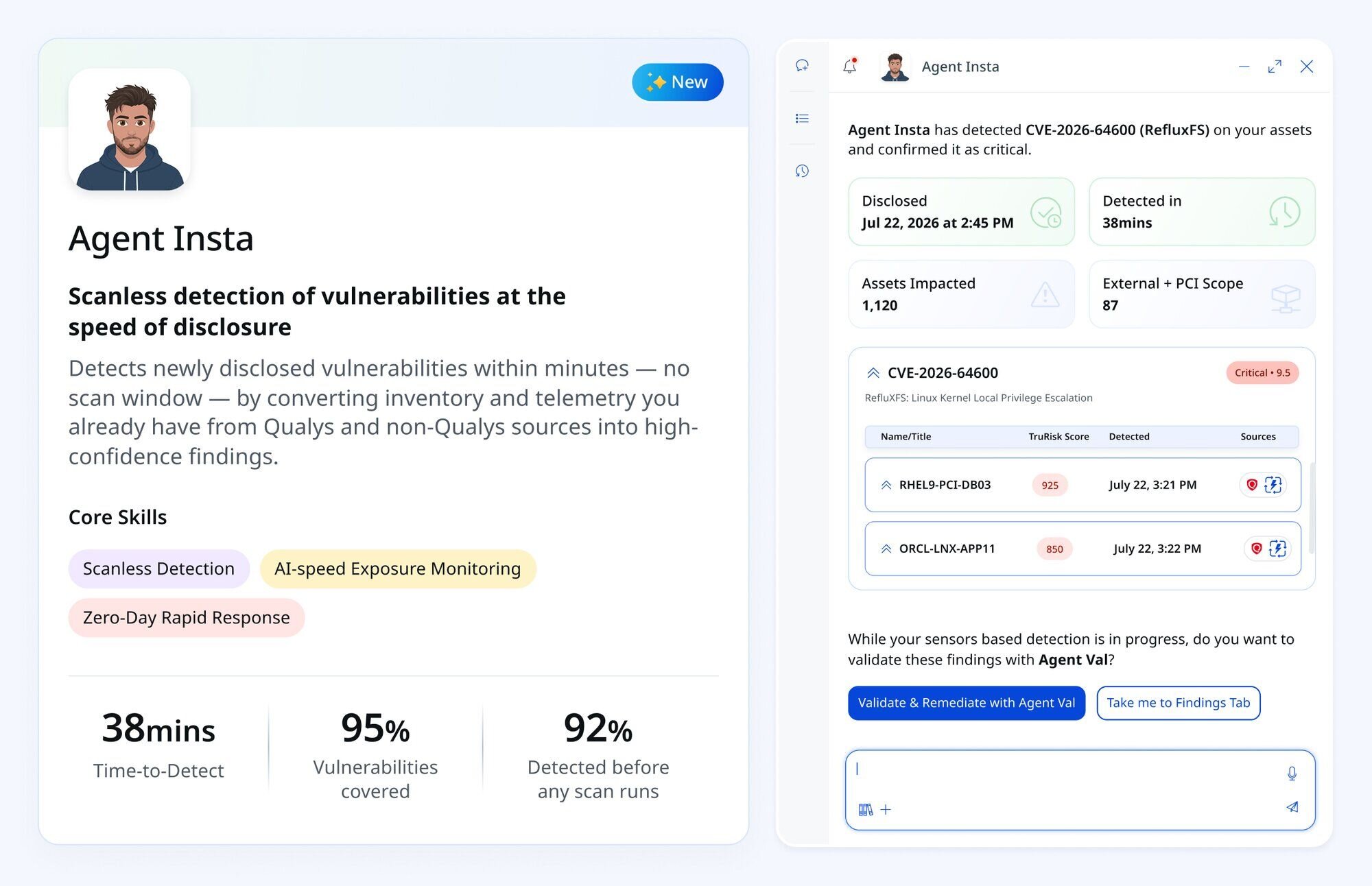
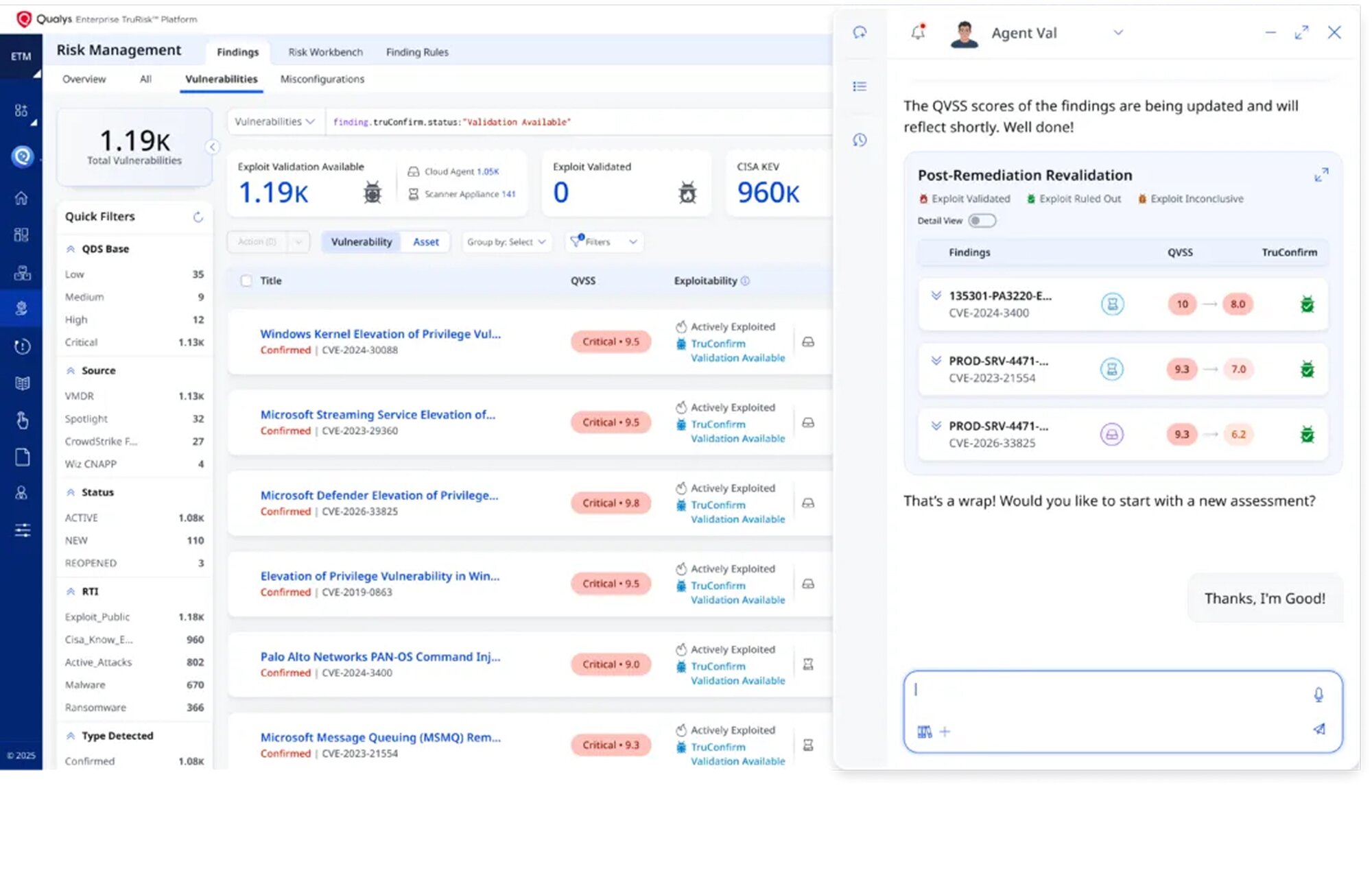
An AI-Native Risk Operations Center combines AI-speed detection, hyper-prioritization, exploitability validation, and risk-based remediation into a continuous operating model focused on measurable risk reduction.

Meet BOD 26-04 With A Risk Operations Center.

An AI-Native Risk Operations Center combines AI-speed detection, hyper-prioritization, exploitability validation, and risk-based remediation into a continuous operating model focused on measurable risk reduction.

The AI-ROC Maps Directly to the Core Requirements of BOD 26-04

Qualys delivers a unified, AI-powered platform to power the ROC, eliminating tool sprawl so security and IT operate as one. The Qualys Government Platform is FedRAMP High authorized, with 400+ inherited technical controls to streamline FISMA, OMB, and Zero Trust reporting, and it moves agencies beyond compliance to sustainable, mission-aligned cybersecurity.

Remediation urgency is set by four attributes of a vulnerability:

Security and IT operations need a shared operating model — one that replaces manual handoffs with continuous, automated workflows across detection, prioritization, and remediation.

This is the foundation of the Risk Operations Center (ROC) powered by Qualys.

AI-Speed Detection

Qualys Platform

Detect exposures before attackers can weaponize them.

#1 Coverage For CVEs & KEV

Hyper-Prioritization

Qualys ETM

Cut the noise. Focus on validated risk.

99.9% Noise Reduction

Autonomous Remediation

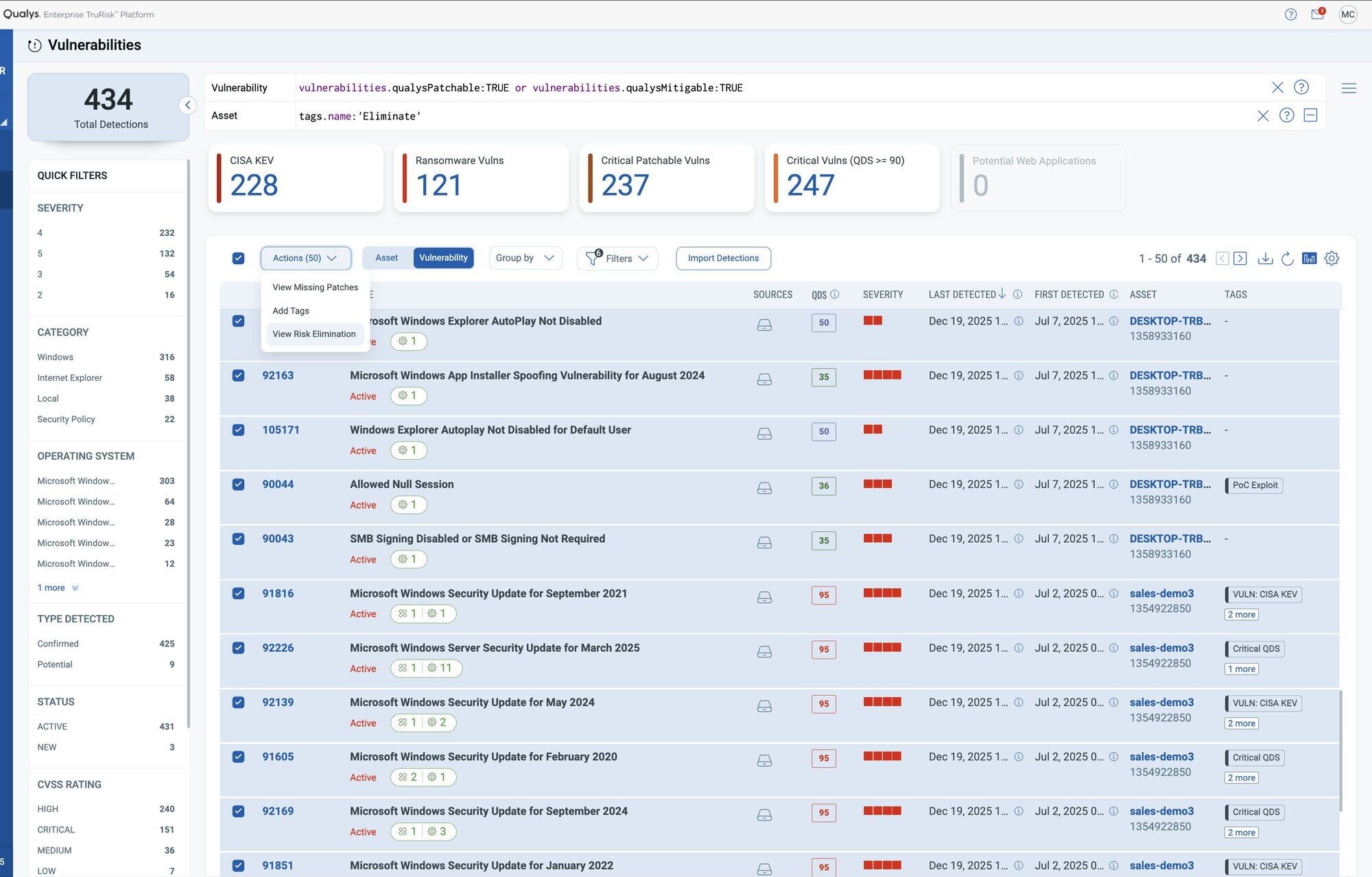
TruRisk Eliminate

Close the highest-risk gaps at machine speed.

150M+ Patches Deployed

Proven Value

MTTR for CISA KEV on Internet Facing Assets: 14 Days Eliminate customers vs 49 Days non customers

150M

Patches deployed

40M+

Autonomous Remediations

<0.1%

<0.1%: Rollback Rate

A Federal Zero-Day — Closed in One Shift, Not Three Weeks

Related Resources

<p class="">Delivering Efficiency in Cyber Risk Management for Federal Agencies with a Risk Operations Center</p>
Whitepaper

Delivering Efficiency in Cyber Risk Management for Federal Agencies with a Risk Operations Center

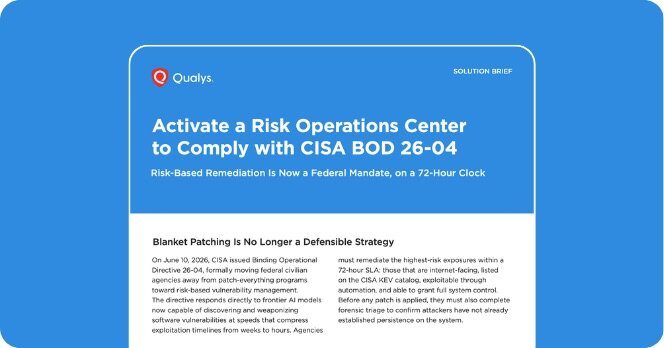
<p>Activate a Risk Operations Center to Comply with CISA BOD 26-04</p>
One-Pager

Activate a Risk Operations Center to Comply with CISA BOD 26-04

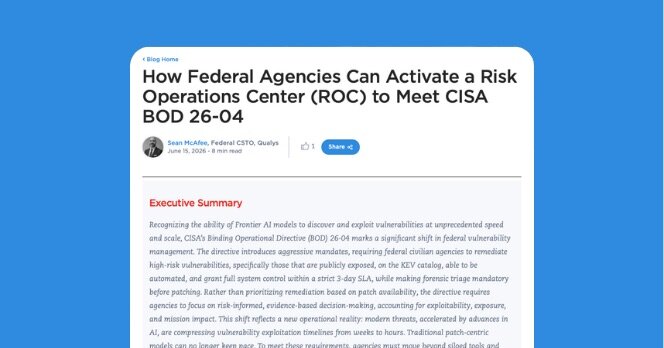
<p>How Federal Agencies Can Activate a Risk Operations Center (ROC) to Meet CISA BOD 26-04</p>
Blog

How Federal Agencies Can Activate a Risk Operations Center (ROC) to Meet CISA BOD 26-04

<p>Federal agencies, suppliers, and commercial organizations seeking the highest levels of cybersecurity face mounting challenges</p>
Report

Federal agencies, suppliers, and commercial organizations seeking the highest levels of cybersecurity face mounting challenges

<p>TotalCloud for Government </p>
Datasheet

TotalCloud for Government

<p>Qualys Enterprise TruRisk™ Platform For Federal Agencies</p>
Solution Brief

Qualys Enterprise TruRisk™ Platform For Federal Agencies

<p>Adopt the Qualys platform in air gapped environments with Private Cloud Platform.</p>
Guide

Adopt the Qualys platform in air gapped environments with Private Cloud Platform.

FAQs for Qualys Government Platform

1. What is CISA BOD 26-04 and which agencies does it apply to?

CISA BOD 26-04 is a mandate for federal civilian agencies that shifts from blanket patching to risk-based vulnerability management. It requires these agencies to remediate high-risk, publicly exposed, and known-exploited vulnerabilities that grant system control within a strict 3-day (72-hour) SLA.

2. How does Qualys help federal agencies comply with BOD 26-04?

Qualys helps agencies comply through its Federal Risk Operations Center (ROC) model. By utilizing Qualys VMDR, Enterprise TruRisk Management (ETM), and TruRisk Eliminate together, teams can efficiently automate detection, hyper-prioritize real-world exposures, and orchestrate rapid remediation to meet the strict 72-hour SLA.

3. What is risk-based vulnerability prioritization under BOD 26-04?

It evaluates exposures based on real-world context rather than treating all vulnerabilities equally. Prioritization requires assessing internet exposure, CISA KEV (Known Exploited Vulnerabilities) alignment, real-world exploitability, and specific asset criticality or mission impact instead of just relying on CVSS scores.

4. Is Qualys FedRAMP authorized?

Yes, the Qualys Government Platform is FedRAMP High Authorized. This certification ensures Qualys provides full-spectrum, hardened cyber risk operations to secure highly sensitive federal workloads and accelerate Authority to Operate (ATO) across demanding government environments.

5. How does Qualys TruRisk prioritize vulnerabilities beyond CVSS scores?

Unlike CVSS alone, Qualys TruRisk evaluates evidence of active exploitation, exploit code maturity, asset criticality, and compensating controls. This comprehensive context reduces the number of critical vulnerabilities to prioritize by up to 85%, ensuring teams focus on operational risks that matter.

6. What are the remediation timelines required by BOD 26-04?

BOD 26-04 mandates a strict 72-hour (3-day) remediation deadline for the highest-risk vulnerabilities—specifically those that are publicly exposed and known-exploited. Lower-risk vulnerabilities can continue to be managed through normal, established change management processes.

7. How does Qualys support continuous monitoring for government agencies?

The Qualys Government Platform offers unified, continuous visibility across IT/OT, cloud, and container environments. It aggregates risk factors, validates fixes in hours to prevent drift, and aligns seamlessly with federal mandates like DHS’s Continuous Diagnostics and Mitigation (CDM) goals.

Prepare Your Agency For The 72-Hour Era.

Operationalize continuous, auditable risk reduction with a AI Risk Operations Center powered by Qualys

Prepare Your Agency For The 72-Hour Era.

Operationalize continuous, auditable risk reduction with a AI Risk Operations Center powered by Qualys.