
Attack Path Analysis (APA) is a proactive cybersecurity approach that identifies how an attacker can move through an environment by chaining together vulnerabilities, misconfigurations, identity exposures, and access relationships to reach critical assets.
Unlike traditional vulnerability scanning, which surfaces individual flaws, APA focuses on how these weaknesses connect. It maps the sequence of steps an attacker could take from an initial foothold, such as an exposed system or compromised credential, through lateral movement and privilege escalation, to high-value targets.
At its core, APA answers three key questions:
An attack path is the sequence of steps an attacker follows to move from an initial entry point to a critical asset. It connects vulnerabilities, misconfigurations, identity exposures, and access relationships into a single, exploitable chain.
Attack paths are typically modeled as graphs, where:
Key components include:
Securing a single chokepoint can eliminate multiple attack paths, making it one of the most effective ways to reduce risk.
Most tools draw attack paths inside the one domain they can see: a cloud tool maps cloud paths, an identity tool maps directory paths, a scanner sees hosts. Attackers don't stop at those borders. A unified attack path is one continuous route from entry point to crown jewel that crosses every domain it needs to (internet edge, cloud, network, identity and on-premises) and draws on every source that found a piece of it. Each step is resolved to one asset identity and scored in one risk language.
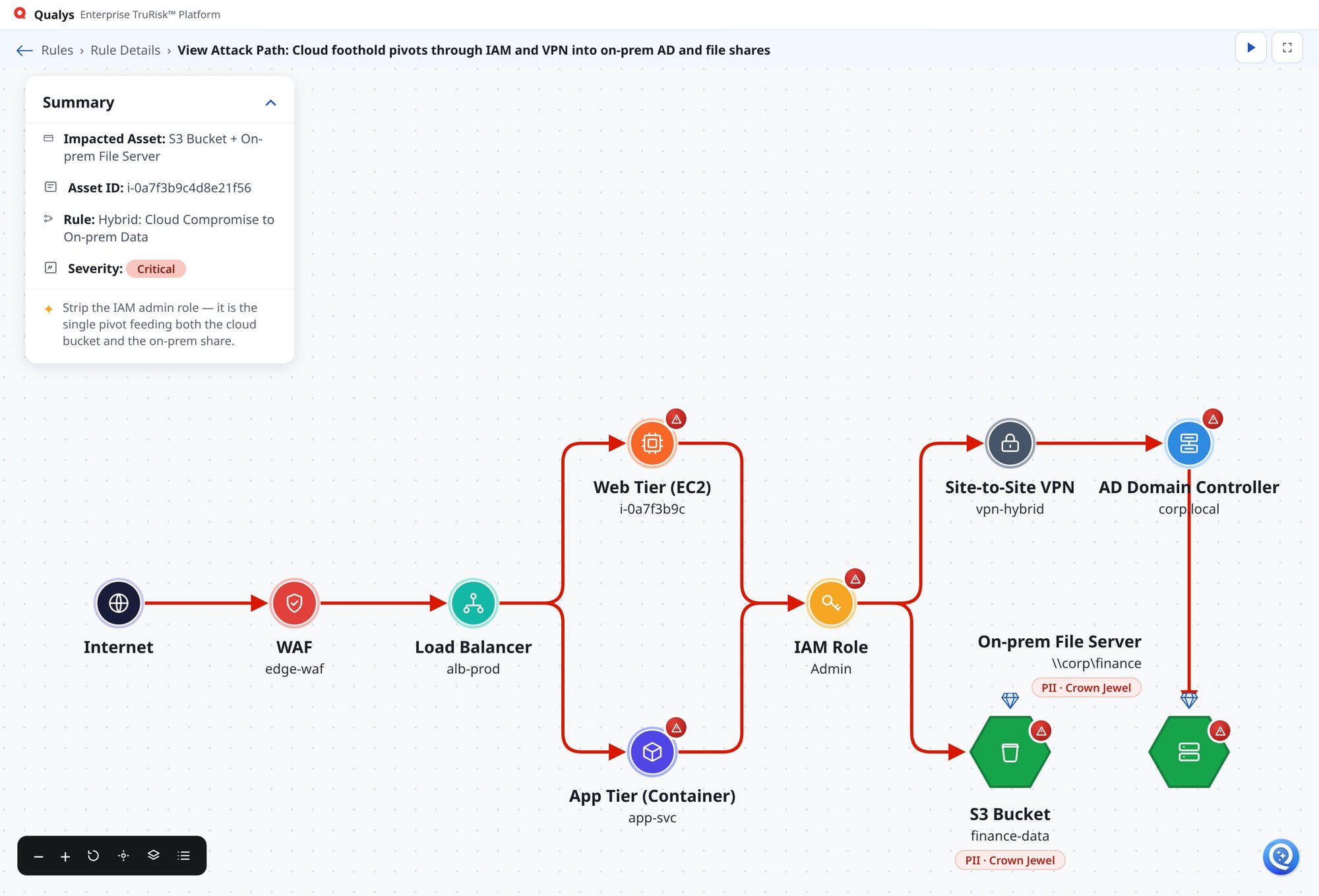
A unified attack path: five domains, findings from several different tools, one route, and one choke point. Strip the cloud admin role, and both crown jewels fall off the path.
For years, vulnerability management was a race to patch faster. Frontier AI has changed the math. AI-assisted research now surfaces serious flaws faster than teams can absorb them. When you can't fix everything, the question changes from "what's most severe?" to "what actually leads somewhere that matters?" Most exposures sit on no path to a critical asset; a handful sit on many. Detect in minutes, prioritize to the minimum, and keep the day for the fix.
Traditional vulnerability management prioritizes individual CVEs based on severity. Attackers do not. They exploit misconfigurations, identity weaknesses, trust relationships and connectivity between systems. A high-severity vulnerability in isolation may pose little risk; a lower-severity issue on a direct path to critical assets may be far more dangerous. The problem is not visibility. The problem is a lack of context.
The Rise of Identity, Cloud, and Hybrid Complexity
Modern environments have moved beyond traditional network boundaries… These critical problems may not appear in CVE databases, yet they can lead to cloud account compromises.
Each tool sees one piece. Put the pieces side by side and you still don't have the route:

Attack path analysis is only as good as the data behind it. Unify findings from every source, including your existing third-party tools and identity providers, then resolve them to one asset identity before you draw a single path.
A unified attack path stitches every exposure, across cloud, on-premises, identity, SaaS and the external attack surface and from every tool that found it, into one continuous route to a critical asset, scored in one risk language. Here's what that changes.
01
See the routes siloed tools miss
02
Fewer fixes, more risk removed
03
One risk language
04
Get more from the tools you own
05
Clear ownership across teams
06
Speed for the frontier-AI era
07
Proof, not theory
08
A metric the board understands
| | Siloed attack paths | Unified attack path |
|---|---|---|
What you see | Fragments inside one domain | The full route, entry to crown jewel |
Data | One tool's findings | Every source, de-duplicated to one asset |
Scoring | Each tool's own severity | One risk score with business context |
What you fix | The worst finding per tool | The choke point that breaks the most paths |
What you report | Findings closed | Paths to crown jewels broken |
| Pattern | The route | Usual choke point |
|---|---|---|
1. Cloud foothold to data | Internet → exploitable web app → over-privileged cloud role → object storage and database | The over-privileged role |
2. Cloud to on-prem pivot | Exposed workload → cloud admin role → site-to-site VPN → Active Directory → file shares | The cloud role that reaches the VPN |
3. Two doors, one domain controller | Phished user via VPN and exposed RDP host → domain controller → cloud identity provider → cloud storage | The domain controller, or the on-prem-to-cloud identity trust |
4. Vulnerable image | Registry image → container → Kubernetes service account → secrets manager → customer database | The service account's permissions |
5. Two front doors, one shared service | Customer web app and partner API → shared service → database and backups | The shared service |
6. The over-permissioned AI agent | Prompt injection or goal hijack → AI agent with broad tool access → internal APIs and data | The agent's permissions and the tools it can call |
Notice the pattern: in almost every case, one identity, permission or shared service sits on most of the route. Four of the six cross at least two domains, which is why a unified attack path finds them and a single-domain view doesn't.
Look closely at almost any attack path and you'll find an identity doing the moving: a hijacked user session, a service account nobody owns, a cloud role with wildcard permissions. Non-human identities now far outnumber people, and most carry more access than they need.
AI agents raise the stakes. Unlike a static service account, an agent decides at runtime what to call, often across directory services, cloud, SaaS and code. Treat every agent as an identity with permissions: inventory it, limit what it can do, watch what it does, and include it in your unified attack paths. An attacker who can steer an agent inherits everything it can reach.
Attack surface defines the exposure, attack vectors define the entry, and attack paths define the impact.
| | Attack surface mgmt | Attack path analysis | Pen test / BAS | CTEM |
|---|---|---|---|---|
Answers | What can be attacked? | How could an attacker reach what matters? | Can this attack succeed now? | Are we reducing exposure that matters? |
Unit | Asset or exposure | Path and choke point | Scenario | Program cycle |
Cadence | Continuous | Continuous, recalculated | Periodic | Continuous |
Step 1: → Unify asset, exposure and identity data
APA begins with comprehensive visibility across assets, vulnerabilities, configurations, and identities. Data is collected from sources such as vulnerability scanners, cloud APIs, identity providers, and endpoint tools. Bring in third-party tools you already run, and resolve every finding to one asset identity so the same server or role doesn't appear three times.
Step 2: Graph Modeling, one graph across every domain. (Existing node and edge text kept.) Model cloud, on-premises, identity and SaaS in the same graph, not separate ones, so paths can cross between them.
Rules vs. probabilistic graphs. Some approaches enumerate every theoretically possible path; others look for specific, high-confidence patterns. Exhaustive graphs find more but bury teams in noise. Pattern-based rules find fewer paths, and each is actionable. Mature programs combine high-confidence rules with validation.
An attack path is a hypothesis: these weaknesses could chain. Before you pull a team off planned work, prove it. Safe, production-grade exploit validation sends a benign test against each step and returns one of three answers: exploitable, blocked by a control, or unreachable. Exploitable steps raise every path through them. Blocked or unreachable steps lower the path's priority, with evidence you can show an auditor.
Environments constantly evolve with new assets, changing configurations, and emerging vulnerabilities. To get the most from attack path analysis, follow these best practices:
Unify your data before you graph it
Include asset discovery across on-premises and cloud environments; integrate identity systems and permissions; map network topology and connectivity; regularly review coverage gaps.
Paths appear only where the connecting attributes exist: reachability, permissions, trust relationships, sensitive-data tags. Feed the graph from every source, including third-party security tools and identity providers, and de-duplicate to one asset identity. A gap in one domain silently breaks every unified path that crosses it.
Break paths, not backlogs
Rank fixes by how many paths to critical assets they close, not by how many findings they clear. One choke-point fix can be worth a thousand patches.
Treat AI agents as identities
Inventory agents and MCP servers along with the permissions and tools they hold, and include them in your attack graph.
Attack Path Analysis shows how an attacker could move. MITRE ATT&CK® shows how attackers actually move.
The MITRE ATT&CK® framework is a key resource for understanding attacker behavior. When used with Attack Path Analysis, it connects theoretical attack paths to real-world actions, helping organizations transition from possible to probable risk.
Each step in an attack path can be mapped to known attacker techniques, such as:
This allows security teams to:
Attack Path Analysis applies to both on-premises and cloud environments, but the nature of attack paths, how they form, and how they are remediated differ significantly. In modern hybrid enterprises, understanding these differences is essential to accurately assessing risk.
Key Differences at a Glance
| Dimension | On-Premises | Cloud |
|---|---|---|
Core Driver | Network + Active Directory | Identity (IAM) + APIs |
Lateral Movement | SMB, RDP, credential reuse | Role assumption, token abuse |
Privilege Escalation | Kerberos attacks, GPO abuse | Over-permissioned IAM roles |
Security Model | Perimeter-based | Identity and policy-based |
Change Rate | Relatively stable | Highly dynamic |
Remediation | IT ops (patching, segmentation) | Cloud engineering (IAM, policies) |
On-Premises Attack Paths: Credential and Network Chains
On-premises attack paths are typically driven by credential theft and network traversal.
A common pattern:
Active Directory sits at the center of these paths. Misconfigurations such as:
can create direct paths from a single compromised system to full domain control.
Cloud Attack Paths: Identity and Access Chains
Cloud attack paths are fundamentally identity-driven. A typical sequence:
Unlike on-prem environments, there is no true network perimeter. Once valid credentials are obtained, movement is governed entirely by permissions. A single misconfigured IAM role can provide access that would require multiple steps in on-prem environments.
Hybrid Attack Paths: The Most Critical Risk
The most dangerous attack paths today are cross-boundary (hybrid). These paths:
Examples include:
These are high-risk because:
This “hybrid blind spot” is where many modern breaches occur.
What Feeds the Attack Graph
| Data Type | On-Premises | Cloud |
|---|---|---|
Assets | CMDB, AD, scanners | Cloud APIs (AWS, Azure, GCP) |
Vulnerabilities | CVE scanners | CVEs + misconfigurations (CSPM) |
Identity | AD, LDAP | IAM roles, service accounts |
Connectivity | Network topology | Security groups, VPC rules |
Trust Relationships | AD trusts, delegation | Cross-account roles, federation |
Remediation: Different Problems, Different Owners
| Risk Type | On-Premises Fix | Cloud Fix |
|---|---|---|
Credential Exposure | Rotate creds, enforce MFA | Rotate keys, use roles |
Excessive Privileges | Remove group access | Tighten IAM policies |
Network Exposure | Segmentation, firewall rules | Security groups, private endpoints |
Trust Misuse | Restrict delegation, AD trusts | Limit cross-account roles |
Neither environment is inherently more dangerous; they differ in how risk manifests.
The highest risk emerges in hybrid environments, where attackers can combine the speed of cloud access with the depth of on-premises control.
Qualys delivers Attack Path Analysis as a core capability within its Enterprise TruRisk™ Management (ETM) platform, bringing together vulnerability management, asset visibility, and exposure management in a single, cloud-native architecture.
For hybrid enterprises, Qualys provides a unified attack graph that spans:
This unified view ensures that risks are not evaluated in isolation, but in the context of how attackers can actually move across environments.
At the foundation of Qualys Attack Path Analysis is TruRisk™, a risk quantification model that goes beyond static severity scoring.
TruRisk evaluates exposures based on:
This allows security teams to prioritize remediation based on actual business risk, not just CVSS scores.
With TotalCloud, Qualys brings cloud context directly into the attack graph by integrating:
Rather than treating these as isolated findings, Qualys connects them into attack paths, showing how a single misconfiguration or permission can lead to critical assets.
This enables visibility into hybrid attack paths such as:
These cross-boundary paths are often invisible to siloed tools but represent some of the highest-risk attack scenarios.
Traditional tools stop at detection. Qualys answers:
For example:
For example, an overly permissive IAM role is mapped as a path from a compromised workload to sensitive data, making the risk immediately actionable.
Qualys identifies chokepoints, the nodes or permissions that appear across multiple attack paths.
This allows teams to:
Attack path insights are integrated directly into remediation workflows via:
This ensures that findings translate into measurable outcomes, not just dashboards.
Qualys supports all stages of the CTEM lifecycle:
This enables organizations to move from exposure visibility to measurable risk reduction.
Qualys brings together attack path analysis, cloud security, identity context, and remediation workflows into a single platform.
Unlike siloed tools that surface isolated findings, Qualys connects exposures across environments, helping teams understand how risk propagates and where to act for maximum impact.
With unified visibility, business-aligned prioritization through TruRisk™, and chokepoint-driven remediation, organizations can move from fragmented security
Qualys treats attack path analysis as part of running cyber risk like an operation: a Risk Operations Center.
With Qualys TotalCloud, security teams can:
With Qualys Enterprise TruRisk™ Management (ETM), security teams can further
The goal is the one this article argues for: fewer, better fixes that break the most paths.
Request a demo to see how Qualys identifies, validates, and helps eliminate real attack paths across your environment.
What is a unified attack path?
A unified attack path is a single, continuous route from an entry point to a critical asset that crosses every domain it needs to (cloud, on-premises, identity, SaaS and the internet edge) and is built from every data source that found a piece of it. Findings are de-duplicated to one asset identity and scored in one risk language, so you see the whole route instead of fragments in separate tools.
What are the benefits of a unified attack path?
You see cross-domain routes that siloed tools miss, fix the choke points that close paths in several domains at once, prioritize on one risk score instead of competing severities, get more value from tools you already own, give each step a clear owner, and report progress as paths to crown jewels are broken.
Why is Attack Path Analysis important?
Traditional security tools often identify vulnerabilities in isolation. Attack Path Analysis provides the context needed to understand which exposures can actually lead to a breach. By revealing how attackers could move through an environment, APA helps security teams prioritize remediation efforts based on real-world risk rather than severity scores alone.
How is Attack Path Analysis different from Vulnerability Management?
Vulnerability Management focuses on identifying and remediating known vulnerabilities such as CVEs. Attack Path Analysis goes a step further by analyzing how vulnerabilities, identities, misconfigurations, and connectivity combine into exploitable attack chains.
Vulnerability Management answers:
What is the difference between an attack path, attack surface, and attack vector?
An attack surface is the set of assets, services, identities, and interfaces that could be targeted.
An attack vector is the specific method used to gain access, such as phishing, credential theft, or exploiting a vulnerability.
An attack path is the complete sequence of steps an attacker follows from initial access to a target asset by combining multiple attack vectors and exposures.
How does Attack Path Analysis work?
Attack Path Analysis builds an attack graph using data from assets, vulnerabilities, identities, network relationships, cloud configurations, and threat intelligence. It then analyzes potential paths that attackers could use to move through the environment and reach critical assets. Modern APA platforms continuously update these paths as the environment changes.
What types of risks can Attack Path Analysis identify?
Attack Path Analysis can identify:
Can Attack Path Analysis identify cloud security risks?
Yes. Modern APA solutions analyze cloud-specific exposures such as misconfigured storage, excessive IAM permissions, exposed services, and cross-account trust relationships. They also map how cloud exposures can connect to identities, workloads, and sensitive data to create exploitable attack paths.
Why are identity-based attack paths important?
Many modern attacks rely on compromised credentials, excessive permissions, and trust relationships rather than solely on software vulnerabilities. Identity-based attack paths reveal how attackers can escalate privileges, move laterally, and gain access to sensitive resources through identity systems such as Active Directory, Entra ID, Okta, and cloud IAM platforms.
How does Attack Path Analysis support Zero Trust?
Zero Trust is based on the principle of "never trust, always verify." Attack Path Analysis helps organizations identify excessive trust relationships, unintended access paths, and over-permissioned accounts that violate Zero Trust principles. This enables teams to implement more effective segmentation and least-privilege controls.
How does Attack Path Analysis align with MITRE ATT&CK®?
Attack Path Analysis and MITRE ATT&CK® complement each other. MITRE ATT&CK® documents real-world adversary tactics and techniques, while APA shows where those techniques could be used within an organization's environment. Mapping attack paths to ATT&CK techniques helps security teams prioritize detection, prevention, and remediation efforts.
How does Attack Path Analysis support CTEM?
Attack Path Analysis is a foundational capability within Continuous Threat Exposure Management (CTEM). It helps organizations discover exposures, prioritize risk based on exploitability and business impact, validate findings in context, and focus remediation efforts on the attack paths most likely to be exploited.
What are chokepoints in Attack Path Analysis?
A chokepoint is a system, identity, permission, or relationship that appears in multiple attack paths. Remediating a chokepoint can disrupt numerous attack paths simultaneously, making it one of the most efficient ways to reduce risk.
What are the biggest challenges of implementing Attack Path Analysis?
Common challenges include:
Organizations with strong asset inventory and exposure management programs typically achieve better APA outcomes.
Can Attack Path Analysis reduce remediation workload?
Yes. By identifying the exposures that contribute to actual attack paths, APA helps teams focus on the vulnerabilities and misconfigurations that matter most. This reduces remediation noise and enables security teams to prioritize actions with the greatest impact on risk reduction.
How is frontier AI changing attack path analysis?
Attackers find and chain weaknesses faster, and AI agents add new identities to chain through. That makes "fix what breaks the most paths" more valuable than "fix the most severe".
Should AI agents be part of attack path analysis?
Yes. Treat each agent as an identity with permissions, and include the tools it can call in the graph.
How does Qualys Attack Path Analysis work?
Qualys Attack Path Analysis is integrated into the Qualys Enterprise TruRisk™ Management platform. It combines vulnerability data, asset context, identity relationships, cloud security posture, and threat intelligence to identify, prioritize, and visualize attack paths across hybrid environments.
Using TruRisk™, Qualys helps organizations focus remediation efforts on the attack paths most likely to impact the business.